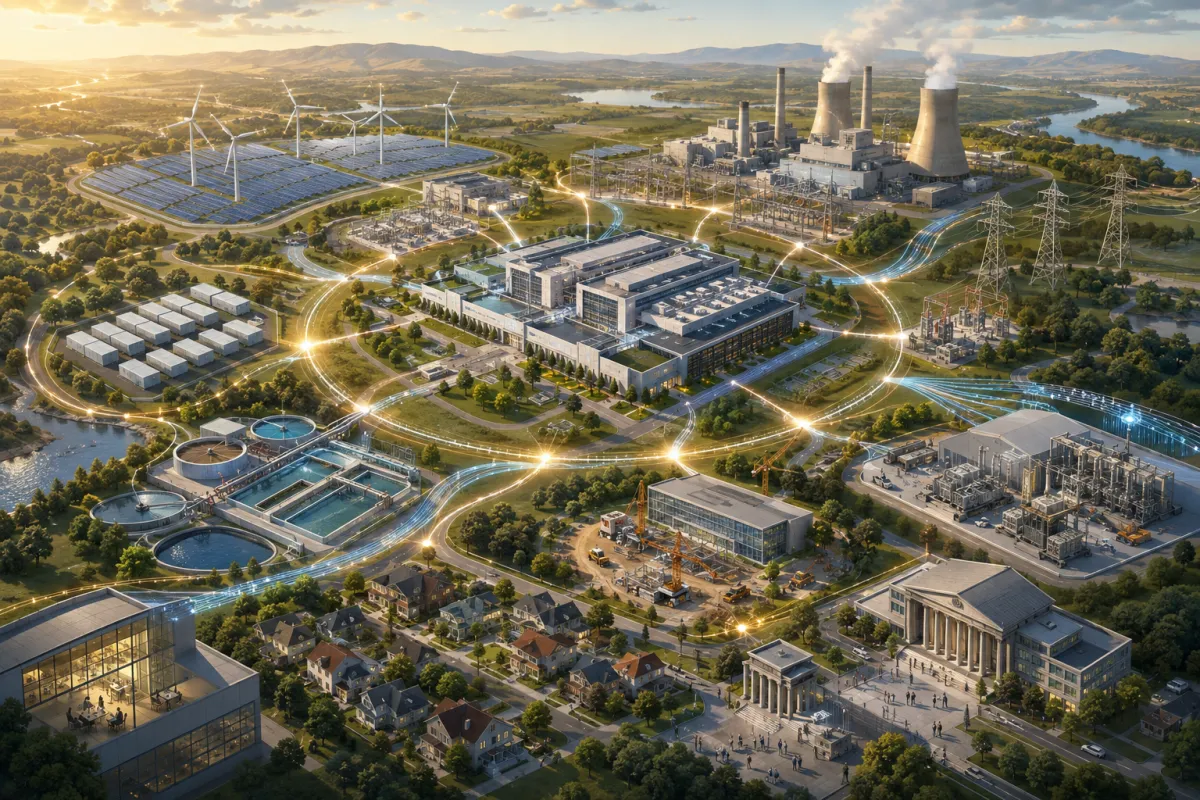
Understanding the industrial ecosystem behind America's next infrastructure buildout
I grew up in the Rust Belt, in a family where manufacturing was simply part of life. Members of my family worked in automotive plants and steel mills, and when I began my own career as a young manufacturing engineer, I followed a path that felt pretty familiar. For roughly the next two decades, much of my career was spent in and around manufacturing operations across the United States.
Many of those plants employed a few hundred people. They weren't enormous automotive assembly plants employing thousands, but they mattered to the communities around them. They provided good jobs, supported local businesses and suppliers, and contributed to the economic fabric of the places where they operated. I also watched what happened when manufacturing operations closed, consolidated or moved outside the United States. The effects rarely stopped at the factory gates.
My career eventually moved increasingly into construction, energy and infrastructure, although there was considerable overlap along the way. Businesses like Hill Phoenix manufactured highly engineered equipment that ultimately had to be installed and perform in the field. Southern States manufactured critical electrical equipment used in the power grid. More recently, my work has involved the development, engineering, construction and operation of energy infrastructure itself.
That combination of experiences influences how I see the enormous data center and power infrastructure buildout now underway in the United States. There are legitimate questions surrounding it. How muchelectricity will data centers require? Where will that generation come from? What are the impacts on water, transmission infrastructure and electricity rates? Who should pay for the infrastructure required to support them? What does the community receive in return? Those are important questions, and responsible development requires that we address them.
But I think there is another part of the conversation that is often overlooked. Most people see the building. They see rows of servers, artificial intelligence and enormous amounts of computing power. Maybe they think about how much electricity or water the facility consumes, or how many people will work there once construction is finished.
I see everything that had to happen before the first server was ever turned on.Follow that trail far enough upstream and the data center starts to look very different. It isn't simply a building full of technology. It sits at the center of an enormous industrial infrastructure ecosystem.
Putting 100 MW Into Perspective
We routinely see announcements for 100 MW, 500 MW and even gigawatt scale data center campuses. Unless you work around power generation or large industrial facilities, those numbers can be difficult to put into perspective.
Consider 100 MW. If a facility were drawing that amount of power continuously, over the course of a year it would consume roughly as much electricity as 80,000 average U.S. homes.That's not a perfect comparison because homes and data centers use electricity very differently, but it gives you a sense of the scale.
And 100 MW is no longer an extraordinary number in the data center conversation. We are increasingly talking about campuses measured in hundreds of megawatts and, in some cases, gigawatts. But the more important point isn't simply the amount of electricity. It's what we expect that electricity to do.
A data center has to operate continuously and reliably. Power has to reach the site, potentially requiring new generation, transmission infrastructure, substations and transformers. Once inside, that power has to be distributed, protected and backed up while sophisticated cooling systems remove the enormous amount of heat generated by the computing equipment. All of that infrastructure exists for something most of us experience very differently.
What Is a Data Center Really Supporting?
Think about how much of modern life now begins with a seemingly simple digital interaction. A student researching a paper. A scientist analyzing an enormous dataset. An engineer running a complex simulation. A business accessing information stored in the cloud. Or any one of us asking an AI model a question.
AI is certainly accelerating demand, but data centers support much more than AI. Banking transactions, healthcare information, telecommunications, e-commerce, corporate systems, manufacturing, logistics and scientific research all depend on computing and storage taking place somewhere.
From our side of the screen, very little of this feels industrial. Yet behind those everyday interactions are physical systems that have to be engineered, manufactured, transported, installed, commissioned, operated and maintained. And every one of those systems has an ecosystem behind it.
Follow the Project Upstream
The physical equipment is only part of the story. Long before a data center becomes operational, developers have to identify and secure a site, understand access to power and water, work through permitting and utility requirements, arrange financing and determine whether the surrounding infrastructure can support what they intend to build.
Then engineering, procurement and construction begin to converge. Long lead equipment has to be specified and ordered, often well before everything else is complete. Manufacturers have to reserve capacity. Contractors and skilled trades have to be available when needed. Schedules across multiple organizations have to align, and decisions made months or even years earlier can determine whether a project stays on track.
This is where the human side of infrastructure becomes easy to underestimate. A project of this scale isn't delivered by equipment. It's delivered by people coordinating thousands of decisions across dozens of organizations, each responsible for a different piece of the outcome.That is why looking only at the finished building misses so much of the story.
I've Watched These Worlds Converge
I've watched pieces of this ecosystem from several different vantage points over my career. At Southern States, I ran manufacturing operations for a company producing high voltage electrical equipment for the utility industry. At the time, lead times for some of the extra high voltage equipment were already measured in months. Today, Southern States is expanding its manufacturing footprint, including production of 345 kV equipment, to increase capacity, improve efficiency and reduce lead times.
That's what scaling to meet a growing infrastructure market looks like at the manufacturing level. A factory manufacturing high voltage electrical equipment in Georgia may seem far removed from a server rack inside a data center. It isn't. That's precisely the point. Later in my career, I moved deeper into construction and renewable power generation, where engineering, procurement, interconnection and project execution became part of my everyday world.
For much of my career, manufacturing, construction and power generation felt like different chapters. Today, they're increasingly part of the same story, and the data center buildout sits at the intersection of all three.
Look Beyond the Building
The next time you see a headline announcing another data center, don't stop at the building. Look upstream and consider what had to happen before that facility could do what it was designed to do.
Behind that facility is a much larger network of manufacturers, utilities, engineers, contractors, skilled trades, project leaders, suppliers and operators. Some may be located near the data center. Others may be hundreds or even thousands of miles away. All of them contribute something necessary to turn a digital idea into physical infrastructure that actually works.
The digital world may feel weightless. The infrastructure underneath it is anything but. That's what I see when I look at the data center buildout. Not simply buildings filled with servers, but the convergence of manufacturing, construction, power and people across an industrial ecosystem that extends far beyond the property line.
The data center may be where the computing happens. But it isn't where the story begins or ends.
Once we look beyond the building, another question becomes difficult to ignore. If we're debating the economic impact of data centers primarily by counting the people who eventually work inside them, are we measuring the wrong thing?
That's the question I'll explore in the next article in this series, where I'll look beyond the data center itself at the manufacturing investment, jobs, suppliers and communities participating in the infrastructure buildout.
In the meantime, I'd like to hear how others see it. If you work anywhere in this ecosystem, whether in manufacturing, power, engineering, construction, project development or operations, what are you seeing from where you sit?
If you're leading a manufacturing or infrastructure company being challenged to grow alongside this buildout, let's talk. Growth creates opportunity, but it can also expose gaps in capacity, leadership, processes and execution. If any of that is beginning to show up in your organization, I'd welcome the opportunity to compare notes and understand what you're seeing. Start the conversation with The Operator's view at operatorsview.com.